
You already know you should be more visible on LinkedIn. You've known for a while. You have a half-finished post sitting in your drafts folder, a few ideas you keep meaning to write down, and a sense that your competitors are showing up in places you're not.
And then something more urgent comes up. It always does.
But while you're deprioritizing it, buyers are Googling you. Candidates are forming opinions before your recruiter ever picks up the phone. Partners are sizing you up before the first call. What they find (or don't find) is shaping decisions you never get to be part of.
In 2026, the gap between executives who show up and those who don't has never been wider.
Let's start with the data, because this isn’t just a “gut feeling.”
According to the 2025 Edelman LinkedIn B2B Thought Leadership Impact Report, 64% of decision-makers spend more than an hour per week consuming thought leadership content. Ninety-nine percent of them say it influences purchasing decisions. These aren't people casually scrolling. These are your buyers, actively looking for reasons to trust someone.
Global executives attribute 63% of their company's market value to its overall reputation, according to Weber Shandwick's The State of Corporate Reputation in 2020. And reputation starts at the top. That's not a marketing problem. That's a business problem.
And here's what's changed on the platform itself: LinkedIn's algorithm had a major structural shift in late 2025. Company pages lost 60-66% of their organic reach between 2024 and 2026. Personal profiles now dominate 65% of feed content. The same post shared by a person instead of a brand page reaches 561% further.
LinkedIn has structurally decided that people, not logos, get the reach. You can argue with that or work with it. But if your company page is doing the talking for your brand and your profile hasn't been updated since 2021, that's a real problem.
Nobody's asking you to become an influencer. You don't need to post every day, share hot takes for engagement, or document your morning routine.
What a B2B executive's personal brand actually looks like is simpler: show up in your area of expertise, consistently, in your own voice. That's it.
For a CEO or founder, that usually means:
Perspective on your industry. What's happening, what it means, what you think buyers or operators are getting wrong; the stuff you'd say in a client meeting or a board presentation but never say publicly.
Honest takes on your own business. What you're building, why, what you've learned. People do business with people they trust, and trust gets built through transparency over time.
Your actual point of view. Not corporate positioning. Not "we're excited to announce." Your take. The thing that makes you different from the person in the same role at a competitor brand.
The executives who do this well don't have the loudest profiles. They have the clearest ones.
The easiest way to understand what this looks like in practice is to look at people already doing it. These three executives have built LinkedIn presences that are working, each in a different way:
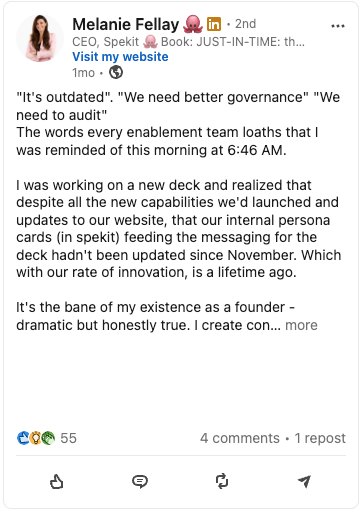
Melanie Fellay — CEO and co-founder of Spekit, a B2B SaaS sales enablement platform. Forbes 30 Under 30. Her LinkedIn content is a mix of honest founder storytelling, sharp product and industry takes on AI and enablement, and real behind-the-scenes moments. She writes like a person, not a press release, and stays tightly focused on her space.
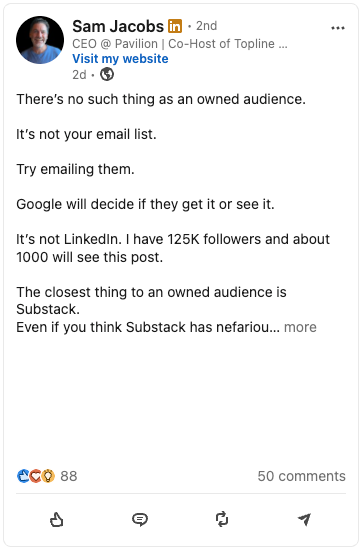
Sam Jacobs — CEO of Pavilion, a B2B executive community. 103,000+ LinkedIn followers. His content is very deliberately tied to business outcomes. He also now teaches a LinkedIn course for executives, which makes him a credible meta-example for this exact post.
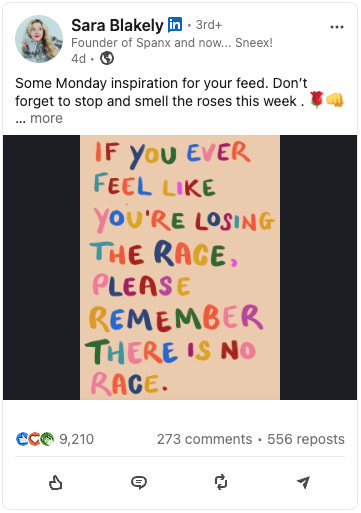
Sara Blakely — Founder of Spanx, now building Sneex. Her LinkedIn voice is warm, personal, and founder-focused, sharing origin stories, failures, and values-driven content rather than product announcements. The content is very human and aspirational.
Here's what executive visibility can actually produce for mid-market B2B companies:
A few things are converging that make this particular moment different from the last few years of "you should really get on LinkedIn."
The algorithm now actively punishes absence. The platform's new AI-driven ranking system rewards consistent, expertise-driven content from individual voices. Generic posts from dormant profiles don't just underperform. They get suppressed.
AI is flooding the feed with noise. Most of what's published on LinkedIn in 2026 reads like it was written by a tool that doesn't know anything specific about anything. Executives with real perspective and real voice stand out more right now than ever.
LinkedIn added Thought Leader Ads. This is newer and worth paying attention to. You can now take a personal post and amplify it through your company's ad account. The combination of authentic individual voice with paid precision targeting is genuinely new.
What is executive personal branding on LinkedIn? Executive personal branding on LinkedIn means building a consistent, visible presence as a leader by sharing your perspective, expertise, and point of view, rather than only posting as your company.
How often should a CEO or founder post on LinkedIn? One to two well-thought-out posts per week is the right rhythm for most executives. Consistency matters more than volume. One strong/authentic post per week, every week, outperforms five forgettable ones.
Is LinkedIn personal branding worth it for B2B companies? Yes. 64% of B2B decision-makers say thought leadership influences their purchasing decisions, and CEO reputation is tied to roughly 44-48% of a company's perceived market value.
Why do company LinkedIn pages have less reach than personal profiles? LinkedIn restructured its algorithm in late 2025. Company pages now receive about 5% of feed allocation while personal profiles dominate 65%.
What should a mid-market executive post on LinkedIn? Industry perspective, honest takes on your own business, and your actual point of view on trends, challenges, or decisions in your space. The content that builds trust isn't polished corporate messaging. It's specific, consistent, and sounds like a person.
At Random, we have extensive and impactful experience creating thought leadership content for executive clients on LinkedIn. Reach out to us if you're ready to start building your executive presence!


